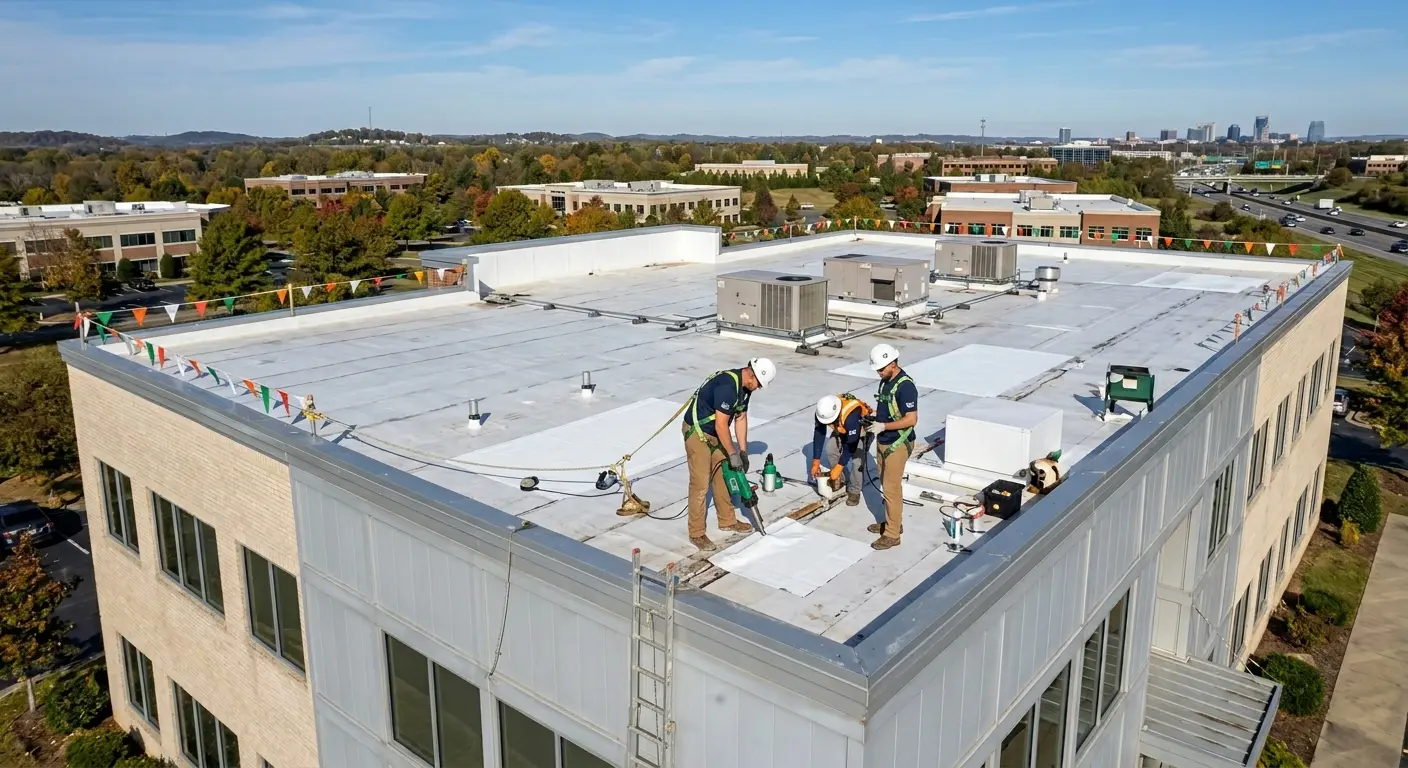
If your building is suffering from leaks or aging materials, securing a professional Commercial Flat Roof Repair is the most effective way to prevent costly structural damage. At Veteran Roofing Systems, we provide high-quality localized solutions for business owners who cannot afford downtime. You can learn more about our specific process on our Commercial Roofing Service Page.
In Middle Tennessee, the 2026 climate has been particularly harsh on roofing membranes. Between the intense summer heat and the rapid freeze-thaw cycles of spring, flat roofs in Franklin and Brentwood undergo significant thermal expansion. This movement often leads to seam failures and structural stress that require immediate professional attention.
Schedule a Commercial Roof Inspection Today
Emergency Leak Repair Available
Common Flat Roof Problems in Franklin & Brentwood Commercial Buildings
Local business owners face unique challenges due to our regional geography and weather. We routinely see roofs that have been battered by high winds and heavy rainfall typical of the Nashville basin.
In our local service area, we frequently encounter:
- Heavy rain and storm cycles: Rapid accumulation of water that tests the integrity of every seam.
- Ponding water: When drainage systems clog or the roof sags, standing water creates a “lens” that magnifies UV damage.
- Seam separation: The adhesive or welds on TPO and EPDM roofs can fail over time due to building movement.
- Flashing failures: The metal or membrane seals around HVAC units and vents are the most common leak points.
- UV damage: High sun exposure leads to membrane cracking and “alligatoring” on older bitumen roofs.
We have successfully performed repairs on:
- Office buildings near Cool Springs.
- Retail centers in Downtown Franklin.
- Warehouses in the Brentwood industrial corridors.
- Multi-family properties across Williamson County.
Types of Flat Roof Repairs
Every material requires a specific technical approach. We follow guidelines set by the National Roofing Contractors Association to ensure every repair meets or exceeds industry standards.
TPO Roof Repair
- Heat-weld seam repairs: We use robotic or hand-held welders to fuse new TPO to the old.
- Patch installation: Targeted patches for punctures or hail damage.
- Leak sealing: Specialized sealants for edge metal and transitions.
EPDM Roof Repair
- Rubber membrane patching: Using EPDM-specific primers and adhesive-backed patches.
- Adhesive seam repair: Re-stripping failed seams to restore the waterproof barrier.
- Penetration resealing: Installing new boots around pipes and supports.
PVC and Modified Bitumen
- Welded PVC patches: Similar to TPO but requires specific PVC-compatible materials.
- Torch-down patching: Using heat to bond bitumen layers for a seamless fix.
- Surface restoration: Applying reflective coatings to extend the life of the repair.
Comparison: Repairing TPO vs. EPDM
| Feature | TPO Repair | EPDM Repair |
| Primary Method | Heat Welding | Chemical Adhesives |
| Curing Time | Instant (once cooled) | 24-48 hours for full set |
| Durability | High (Monolithic bond) | Moderate (Glue-based bond) |
| Climate Sensitivity | Sensitive to dirt during weld | Sensitive to moisture during glue |
Commercial Flat Roof Repair Cost in Franklin & Brentwood, TN
The cost of Commercial Flat Roof Repair depends heavily on how long the damage has been neglected. Water that enters the insulation (the “substrate”) requires more labor and material to fix than a simple surface puncture.
Typical commercial repair costs for 2026:
- Minor repairs: $500 – $2,500 (Small patches or flashing fixes).
- Moderate repairs: $2,500 – $10,000 (Large seam repairs or replacing wet insulation).
- Major repairs: $10,000+ (Extensive damage across multiple roof sections).
Pricing factors include:
- Roof size: Larger areas require more staging and material.
- Material type: TPO is generally more labor-intensive to repair than EPDM.
- Extent of damage: Presence of mold or rotted decking significantly increases costs.
- Accessibility: High-rise or difficult-to-reach roofs require specialized safety equipment.
For more information on managing costs, visit our Roof Repair Page.
Should You Repair or Replace Your Commercial Roof?
Building owners often worry that a repair is just a “band-aid.” While sometimes true, a high-quality Commercial Flat Roof Repair can often buy you another decade of service life. We base our recommendations on the IBHS Fortified Commercial standards to ensure your building remains resilient.
Repair is best when:
- Damage is localized to one area.
- The roof is under 15–20 years old.
- The underlying structure and insulation are still dry.
Replacement is better when:
- You see widespread membrane failure or “shattering.”
- There are multiple recurring leaks in different areas.
- The cost of the repair exceeds 25-30% of a full replacement.
We pride ourselves on honest assessments. If a repair is all you need, that is exactly what we will recommend.
Recent Project Example: TPO Repair in Franklin, TN
We recently assisted a commercial property manager in Franklin whose building was suffering from mysterious leaks in the warehouse area. Our team performed a comprehensive Roof Inspection and found that the TPO seams had begun to separate due to poor initial installation.
Our process included:
- Full moisture scan: We used infrared technology to ensure no water was trapped in the insulation.
- Heat-welded seam repair: We cleaned and re-welded over 200 linear feet of compromised seams.
- Drainage correction: We cleared the internal drains and installed new strainers.
- Preventative sealing: We added reinforced perimeter strips to prevent future wind uplift.
The result:
The leaks were eliminated, and the client avoided a $150,000 replacement. By choosing a targeted Commercial Flat Roof Repair, they extended their roof life by an estimated 7 years.
Signs Your Commercial Flat Roof Needs Repair
Check your building for these “Red Flags” every quarter. Early detection is the key to saving money.
- Water stains inside building: Check the ceiling tiles and perimeter walls.
- Standing water on roof: If water is still there 48 hours after rain, you have a problem.
- Cracked or bubbling membrane: This often indicates moisture is trapped underneath.
- Loose seams or flashing: If you can lift the edge of a seam with your finger, it’s failing.
- Rising energy costs: Wet insulation loses its ability to keep your building cool.
If you are dealing with storm-related damage, we can help you navigate the Insurance Claims process to ensure your repairs are covered.
Get a Professional Flat Roof Inspection Today
At Veteran Roofing Systems, we help Middle Tennessee businesses protect their assets. Our team is veteran-owned and operated, bringing military-grade precision to every Commercial Flat Roof Repair project we undertake in Franklin and Brentwood.
- Fast response times: We know leaks don’t wait for business hours.
- Honest assessments: We prioritize repairs over replacements whenever possible.
- Experienced team: Our technicians are certified in all major commercial systems.
Call Now or Request a Free Inspection
FAQ: Commercial Flat Roof Repair
How much does flat roof repair cost in Franklin TN?
Most local repairs range from $500 to $10,000, depending on the material and the extent of the water intrusion.
Can a commercial flat roof be repaired instead of replaced?
Yes, provided the insulation is dry and the membrane has not reached its end-of-life brittleness.
What is the most common cause of flat roof leaks?
Seam failure, ponding water, and failed flashing around HVAC units are the top three causes we see in Middle Tennessee.
How long do flat roof repairs last?
A professionally executed repair using the correct materials can last 5–10 years or more.
Do you offer emergency commercial roof repair?
Yes, we provide 24/7 emergency leak repair to protect your interior assets during major storms.
Written by Veteran Roofing Systems
Commercial roofing contractor serving Franklin, Brentwood, and Middle Tennessee. Reviewed by experienced roofing professionals with real field experience in commercial flat roof systems. For further technical reading, we recommend the Roofing Industry Committee on Weather Issues.
Call Us Now: +1 629-302-3407
Reviews
Commercial Roofers: How to Find Trusted Roofing Experts
Finding reliable commercial roofers is one of the most important decisions a Tennessee business owner will make for their property. […]
Read More… from Commercial Roofers: How to Find Trusted Roofing Experts

Roof Repair Columbia TN: The Real Cost of Ignoring Roof Damage
In Columbia TN, where summer heat and seasonal storms regularly test your home’s durability, even minor roof damage can lead […]
Read More… from Roof Repair Columbia TN: The Real Cost of Ignoring Roof Damage

Roof Inspection Tennessee: How Often Should You Schedule One?
Roof Inspection Tennessee Why It’s More Important Than You Think When you own a home in Tennessee, your roof is […]
Read More… from Roof Inspection Tennessee: How Often Should You Schedule One?