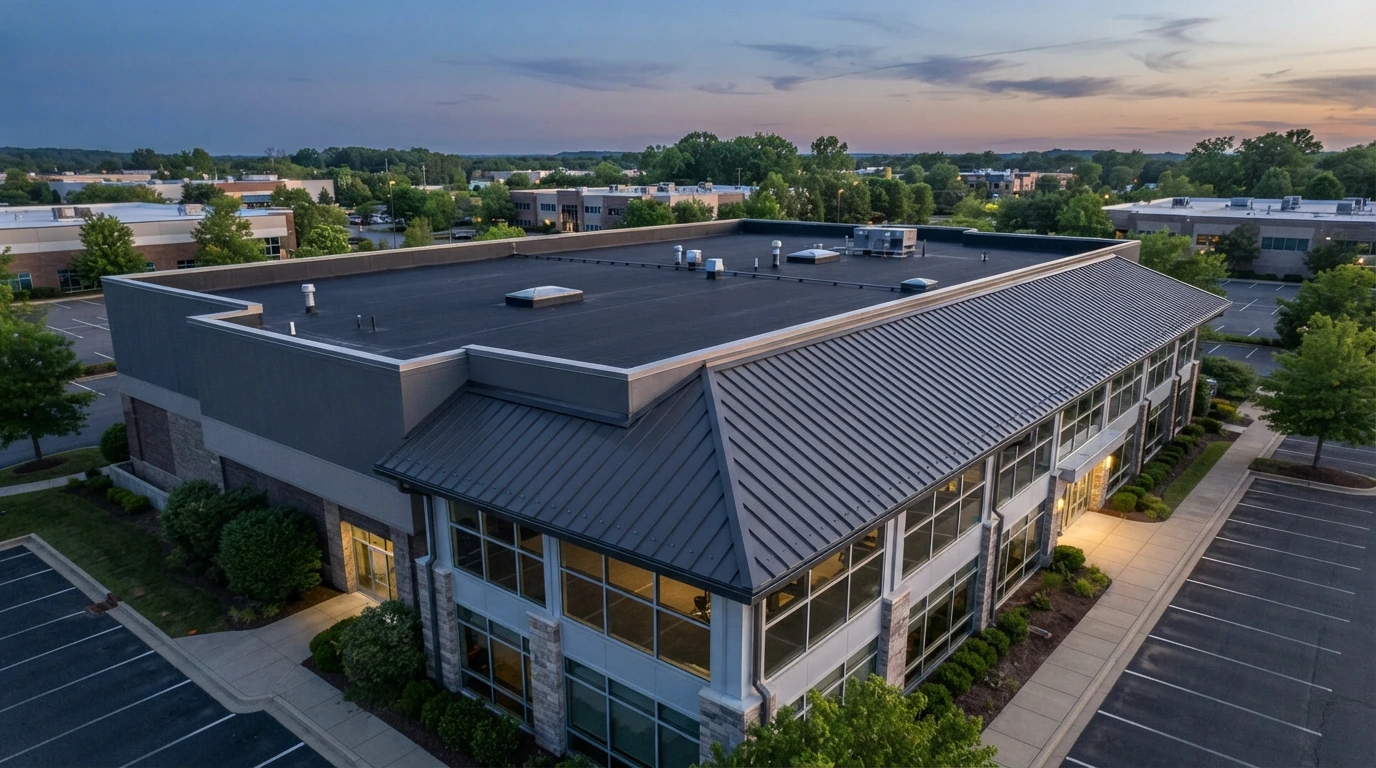
If you own or manage a business property in Tennessee, understanding the different commercial roofing types available today can save you thousands of dollars over the life of your building. Flat and low slope commercial roofs face different demands than a typical house roof, including ponding water, constant UV exposure, and rooftop foot traffic. Veteran Roofing Systems has installed and repaired nearly every major roofing system across Middle Tennessee, so we know which materials hold up and which ones fail early. This guide compares the four leading roofing systems so you can choose the right one for your budget, climate, and building.
Commercial roofs differ from residential roofs in almost every way. Most business buildings use flat or low slope designs, which call for membrane systems instead of asphalt shingles. Our team at Veteran Roofing Systems installs and services complete commercial roofing systems built for these flat and low slope applications, sizing every recommendation to your building’s drainage, foot traffic, and rooftop equipment.
The Four Most Common Commercial Roofing Types
Tennessee property owners generally choose from four proven systems. Each material handles heat, moisture, and foot traffic differently, and each comes with its own cost profile.
- TPO: a reflective, heat welded membrane popular for energy savings.
- EPDM: a flexible rubber membrane known for decades of reliable performance.
- PVC: a chemical resistant membrane built for restaurants and industrial roofs.
- Metal: a long lasting panel system suited to sloped commercial buildings.
TPO Roofing: Pros, Cons and Costs
TPO has become one of the most installed commercial roofing types in the country over the past decade. Learn more about our TPO roofing services in Middle Tennessee.
Pros
- Reflects sunlight to lower cooling costs
- Heat welded seams resist water intrusion
- Lightweight and fast to install
- Available in multiple thicknesses for budget flexibility
Cons
- Newer material with less long term field data than rubber membranes
- Quality varies significantly between manufacturers
- Punctures from foot traffic require prompt repair
Cost: TPO typically runs $4 to $8 per square foot installed, making it one of the most affordable options for flat roof buildings.
EPDM Roofing: Pros, Cons and Costs
EPDM rubber roofing has protected commercial buildings since the 1960s, giving it the longest proven track record of any material on this list, as documented by the EPDM Roofing Association. Explore our EPDM roofing options for Tennessee properties.
Pros
- Decades of proven field performance
- Excellent resistance to hail and thermal shock
- Simple, cost effective repairs
- Performs well in cold and variable climates
Cons
- Black surface absorbs heat, raising cooling costs
- Adhesive seams can loosen over time
- Less reflective than TPO or PVC
Cost: EPDM installation generally costs $4 to $7 per square foot, similar to TPO but backed by a much longer service history.
PVC Roofing: Pros, Cons and Costs
PVC membranes bring chemical and grease resistance that restaurants, auto shops, and manufacturing facilities need. Our PVC roofing systems hold up where other membranes fail.
Pros
- Resists grease, chemicals, and animal fats
- Heat welded seams create a watertight bond
- Highly reflective surface reduces energy use
- Strong fire resistance rating
Cons
- Higher material cost than TPO or EPDM
- Can become brittle in extreme cold if poorly formulated
- Fewer manufacturers compared to TPO
Cost: Expect to pay $6 to $10 per square foot for PVC, reflecting its specialized performance.
Metal Roofing: Pros, Cons and Costs
Standing seam metal roofing remains the longest lasting option among all commercial roof materials, often outlasting membrane systems by fifteen years or more.
Pros
- Lifespan of 40 to 60 years with minimal maintenance
- Sheds snow and rain efficiently on sloped roofs
- Highly resistant to wind, fire, and impact
- Increases property resale value
Cons
- Highest upfront installation cost
- Requires sloped roof design, not ideal for flat buildings
- Can be noisy during heavy rain without proper insulation
Cost: Metal roofing costs range from $8 to $12 per square foot installed, the highest of the four options but with the longest lifespan by far.
TPO vs EPDM: What Is the Real Difference?
Business owners comparing roofing systems most often ask about TPO versus EPDM, since both are single ply membranes that perform very differently on the roof.
- Colour: TPO is white and reflective. EPDM is black and heat absorbing.
- Seams: TPO seams are heat welded. EPDM seams rely on adhesive tape or liquid adhesive.
- Climate fit: TPO suits hot Tennessee summers. EPDM suits buildings that need flexibility through freeze thaw cycles.
- Lifespan: Both average 20 to 25 years with proper maintenance and timely repairs.
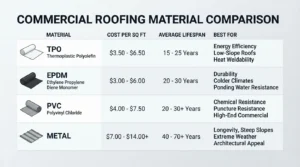
Cost and Lifespan Comparison Table
| Material | Cost per Sq Ft | Average Lifespan | Best For |
| TPO | $4 to $8 | 20 to 25 years | Warm climates, budget conscious owners |
| EPDM | $4 to $7 | 20 to 25 years | Cold climates, hail prone areas |
| PVC | $6 to $10 | 20 to 30 years | Restaurants, chemical exposure |
| Metal | $8 to $12 | 40 to 60 years | Sloped roofs, long term ownership |
How to Choose the Right Commercial Roofing Type for Your Building
The best commercial roofing types for your property depend on four factors specific to your building.
- Roof slope: Flat roofs need membranes like TPO, EPDM, or PVC. Sloped roofs perform best with metal panels.
- Foot traffic: Rooftop HVAC access favors puncture resistant membranes like PVC.
- Local weather: Tennessee’s hot, humid summers favor reflective materials such as TPO or PVC.
- Budget and timeline: EPDM and TPO install faster and cost less upfront than metal or PVC.
A professional roof inspection helps confirm which system fits your building before you commit to a material. Our estimators also walk you through flexible financing options so cost never has to delay a necessary roof replacement.
Why Tennessee Businesses Trust Veteran Roofing Systems
Veteran Roofing Systems is a GAF certified commercial roofing contractor, and we hold Tennessee General Contractor License number 82796, verifiable through the Tennessee Department of Commerce and Insurance. We also follow installation standards published by the National Roofing Contractors Association on every job we complete. Every membrane and metal system we install can be specified to meet ENERGY STAR cool roof guidance where reflectivity matters most for your energy bills.
Whether your property needs a full replacement or a second opinion on which roofing material will perform best, our estimators provide honest, no pressure recommendations. Call 931-225-9987 to schedule a free commercial roof inspection anywhere in Middle Tennessee.
Frequently Asked Questions
What are the most common commercial roofing types for businesses?
TPO, EPDM, PVC, and metal are the most common commercial roofing types. Thermoplastic membranes like TPO reflect heat efficiently to cut energy bills, while rubber EPDM delivers reliable, weather resistant protection for commercial roofing across Tennessee.
How much do different commercial roofing types cost to install?
Commercial roofing costs generally range between $4 and $12 per square foot depending on materials. Single ply membranes like TPO sit on the lower end, whereas standing seam metal systems require higher upfront investment but offer superior longevity.
How do I choose the best commercial roofing material for my building?
Select your material by evaluating roof slope, foot traffic, local weather, and budget. Flat roofs benefit from seamless TPO or EPDM, while sloped facilities often perform better with durable metal panels designed to withstand severe storms.
How long does a commercial flat roof typically last?
Most commercial flat roofs last between 20 and 30 years with proper installation and preventative care. EPDM and TPO systems average 20 to 25 years, whereas premium metal roofs can easily exceed 40 years before replacement becomes necessary.
What is the difference between TPO and EPDM roofing for commercial businesses?
TPO is a white, heat welded membrane that reflects solar heat to lower cooling costs, making it ideal for warmer climates. Black EPDM rubber absorbs heat, relies on adhesive seams, and excels in colder environments requiring flexible durability.
Final Thoughts
Choosing among the available roofing options comes down to four things: your roof slope, your local climate exposure, your budget, and how long you plan to own the building. TPO and EPDM offer the fastest, most affordable path to a watertight flat roof. PVC earns its keep on properties with grease or chemical exposure. Metal remains the strongest long term investment for sloped commercial structures. Veteran Roofing Systems installs, repairs, and inspects every one of these systems across Columbia, Franklin, Spring Hill, Brentwood, and the rest of Middle Tennessee. Call 931-225-9987 or request a free estimate online to get a straight answer on which commercial roof fits your building and your budget.
Veteran Roofing Systems
Call Us Now: +1 931-225-9987
Reviews

Roof Repair Columbia TN: The Real Cost of Ignoring Roof Damage
In Columbia TN, where summer heat and seasonal storms regularly test your home’s durability, even minor roof damage can lead […]
Read More… from Roof Repair Columbia TN: The Real Cost of Ignoring Roof Damage

Residential Roof Repair & Replacement Services in Nashville, TN
A strong and well-maintained roof is essential for every home. For Nashville, TN homeowners, residential roof repair and replacement services […]
Read More… from Residential Roof Repair & Replacement Services in Nashville, TN

Commercial Flat Roofing Explained: Benefits, Materials
Commercial Flat Roofing for Modern Businesses TN Commercial flat roofing is one of the most reliable and cost-effective solutions for […]
Read More… from Commercial Flat Roofing Explained: Benefits, Materials