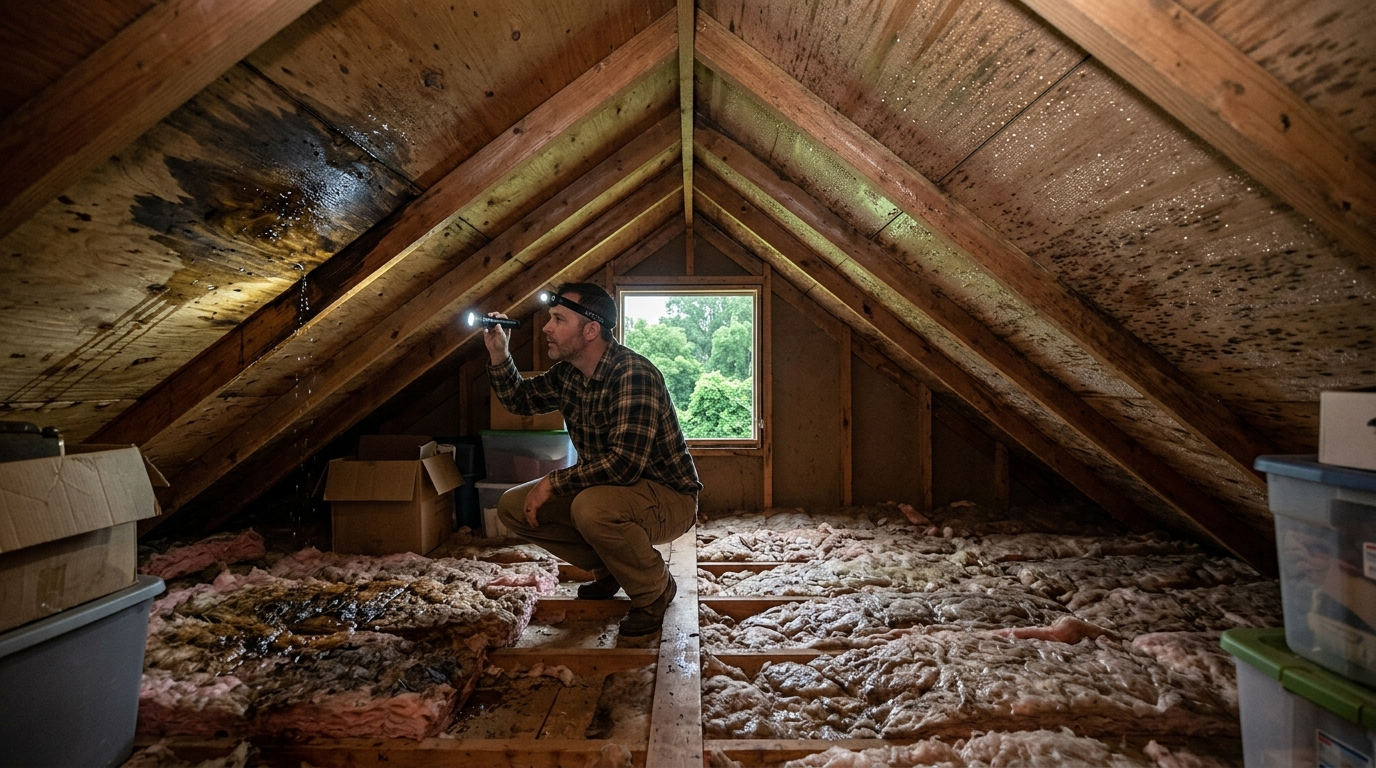
A roof leak or attic condensation can leave the same mark on your ceiling, and most homeowners cannot tell which one they have at first glance. “I found a wet spot on my ceiling. Is my roof leaking?” It is the question we hear most after a rainy week or a cold snap in Middle Tennessee.
The answer matters because the fixes are completely different. Patching a roof will not cure a ventilation problem. Adding vents will not repair a broken pipe boot. This guide shows you how to tell the two apart, what you can check safely and when to call a pro.
| Quick Answer: how to tell the difference fast
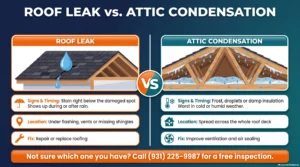
• Roof leak: Moisture shows up in one spot, usually during or right after rain. • Condensation: Dampness spreads across a wide area and appears on cold or humid days, even without rain. • Frost or droplets on roof nails point to condensation. A water trail from one roof opening points to a leak. • Not sure? Only an in-person inspection can confirm the cause. |
Not sure which one you have? Call (931) 225-9987 for a free inspection.
What Is a Roof Leak?
A roof leak happens when rain or melting snow gets through the roof covering and into your home. Water follows a path from the opening, so the damage usually shows up near or below the source.
Common causes in Tennessee homes include:
- Cracked or missing shingles after wind or hail
- Failed flashing around chimneys, vents and valleys
- Worn pipe boots around plumbing vents
- Clogged gutters that push water back under the roof edge
- Aging shingles that have lost their seal
Typical signs of a roof leak:
- A ceiling stain that grows after rain
- Drips or wet spots in the attic
- A dark streak on a rafter below a roof opening
- A small patch of damp insulation
What Is Attic Condensation?
Attic condensation forms when warm, moist air from your living space meets a cold surface in the attic. The moisture turns into water on the roof deck, the nails or the ductwork. No hole in the roof is needed.
Common causes include:
- Bathroom fans or dryers that vent into the attic instead of outside
- Air leaking up through attic hatches, recessed lights and wall tops
- Poor ventilation that traps humid air
- Too little insulation, which lets heat escape into the attic
Why it happens in Tennessee: Our climate swings between hot humid summers and cold winters. In winter, warm indoor air meets a cold roof deck. In summer, a humid attic in Tennessee can sweat on cool AC ductwork. These temperature swings give moisture many chances to condense.
When we inspect attics in Maury County homes, we often find bath fan ducts that end in the attic instead of outside. 20 years of experience have taught us to check that first.
Typical signs of attic condensation:
- Frost on roof nails in cold weather that drips when it warms up
- Damp insulation across a wide area
- Dark or stained roof decking
- A musty smell in the attic
- Moisture even when it has not rained
Roof Leak or Attic Condensation? How to Tell the Difference
Use this table to compare what you see. These are general patterns, and some homes have both problems at once.
| What to check | Roof leak | Attic condensation |
| Timing | During or soon after rain | Cold or humid days, often with no rain |
| Location of moisture | One spot near a roof opening or damaged area | A wide area across the roof deck or attic |
| Weather link | Follows rain and wind-driven storms | Follows temperature swings and humidity |
| Smell | Damp smell near the wet spot | Musty smell across the attic |
| Frost or droplets | Rare | Frost on nails in winter or droplets on decking and ducts |
| Stain pattern | A concentrated stain that may grow after storms | Faint, widespread staining or dark spots on decking |
Simple DIY Checks You Can Do Safely
Safety first: Stay off the roof. A wet or icy roof is dangerous. Do every check from inside the home or from the ground.
- Flashlight check. Open the attic hatch and look around with a flashlight. Look for drips and dark streaks on rafters near vent pipes and chimneys. Stand on a sturdy board or walkway. Never step on the drywall between the joists.
- After-rain check. Look again within a few hours after rain. Fresh wet streaks near one spot suggest a leak.
- Humidity check. An inexpensive hygrometer shows indoor humidity. The EPA suggests keeping it roughly between 30 and 50 percent. If your readings stay higher, moisture may be reaching the attic.
- Fan check. From outside, find the cap where your bath fan vents. Run the fan and feel for airflow. No cap or no airflow is a red flag.
Before you decide between a roof leak or attic condensation, gather these clues. They help a roofer find the cause faster. While you are in the attic, listen for odd sounds too. Our guide to strange sounds in your attic explains what dripping, popping and scratching can mean.
Book Your Free Roof and Attic Inspection. We check for both leaks and moisture. Call (931) 225-9987.
Attic Mold and Wet Insulation: Why You Should Not Wait
Wet attic insulation loses its insulating power. It also holds moisture against the roof deck. Left alone, attic moisture can rot wood and lead to attic mold.
The EPA’s mold guidance stresses that controlling moisture is the key to controlling mold. It also advises drying wet materials quickly.
Wet insulation often needs to be removed and replaced. It rarely dries fully in a closed attic. If you see widespread dark growth, treat it as a job for a qualified professional. Do not disturb it without protection.
How to Fix Each Problem
If it is a roof leak, the fix is to repair the source. That may mean replacing damaged shingles, resealing or replacing flashing or installing a new pipe boot. Once a leak is confirmed, our roof leak repair cost guide shows typical price ranges by repair type.
If it is condensation, the fix is to control moisture and airflow. Good ventilation lets humid air escape before it condenses. Our guide to attic ventilation explains how intake and exhaust vents work together. The usual steps are:
- Vent bath fans and dryers outdoors through a proper duct and cap
- Seal air leaks around hatches, wires and recessed lights
- Balance ventilation with soffit intake and ridge or roof exhaust
- Keep soffit vents clear with baffles so insulation does not block them
- Bring insulation to the right level for your home
Some fixes fall outside roofing. A bath fan duct or an HVAC problem may need an electrician or HVAC technician. We will tell you honestly when that is the case.
How to Prevent the Problem
Prevention is simpler than repair. Use bath fans during and after showers. Keep gutters clean. Check your attic every spring and fall. For a step-by-step look at sealing air leaks, see the ENERGY STAR guidance on sealing and insulating. A humid attic in July often points to weak ventilation, so do not ignore it in summer.
When to Call a Professional
Call a roofer if you notice any of these:
- A ceiling stain that grows after each rain
- A bulging, sagging or bubbling ceiling
- Wet insulation over more than a small patch
- Visible mold or a strong musty smell
- Frost on roof nails every winter
- Moisture that returns after a DIY fix
- Missing shingles or exposed flashing after a storm
- No safe way to reach your attic
Call an electrician right away if water is near wiring or light fixtures.
Real job example: This past August, a homeowner in Columbia, TN called us after a brown stain showed up on her hallway ceiling. She was sure the roof was leaking. When we checked the attic, we found damp insulation and moisture on the underside of the roof decking, but no steady drip path coming through the shingles. Poor airflow was trapping humid air from the house in the attic. Because the shingles were also near the end of their life, we replaced the roof, installed new synthetic underlayment, and added proper attic ventilation so the moist air could escape. The crew finished the job in two days, and the ceiling stain has not come back. That is why we always check ventilation before blaming the shingles.
Frequently Asked Questions
How can I tell a leak from condensation?
Check the timing and the pattern. A leak usually appears in one spot during or right after rain. Condensation spreads across a wide area and shows up on cold or humid days, often with frost on roof nails. Because homes can have both, an in-person inspection is the best way to confirm.
Can attic condensation damage my roof?
Yes. Repeated moisture can stain and soften roof decking, soak insulation and encourage mold. Over time it can shorten the life of the roof system. Fixing the source, usually ventilation and air leaks, stops the cycle. Have a professional inspect any materials that stay wet.
Why is my attic damp in winter in Tennessee?
Warm, moist air from the house rises into the attic and meets a cold roof deck. The moisture turns into frost or droplets, especially during cold snaps and temperature swings. Bath fans venting into the attic, air leaks and weak ventilation make it worse. A damp attic in winter is a warning sign.
Can a bathroom fan cause attic moisture?
Yes. A fan that vents into the attic dumps warm, humid air right where it can condense. Bath fans and dryers should vent outdoors through a proper duct and cap. If you are unsure where yours ends, check with a flashlight from the attic and call a pro if needed.
Should I replace wet attic insulation?
Often yes, especially if it stays wet, smells musty or shows mold. Wet insulation loses its insulating value and holds moisture against the roof deck. Find and fix the moisture source first, or the new insulation will get wet too. A roofer can inspect before you decide.
Conclusion
Whether it is a roof leak or attic condensation, moisture damage gets worse with time. Small stains turn into rotted decking, wet insulation and mold if no one acts. The good news is that the cause is usually easy to find once a trained eye looks at it.
Book Your Free Roof and Attic Inspection. Call (931) 225-9987. Veteran Roofing Systems serves homeowners in Columbia, Spring Hill and nearby Middle Tennessee communities. See our local page for roofing in Spring Hill or call us today.

Commercial Flat Roof Repair in Franklin & Brentwood, TN (Complete 2026 Guide)
If your building is suffering from leaks or aging materials, securing a professional Commercial Flat Roof Repair is the most […]
Read More… from Commercial Flat Roof Repair in Franklin & Brentwood, TN (Complete 2026 Guide)

How to Spot Hail Damage on Your Roof: A Columbia, TN Checklist
Knowing how to spot hail damage on your roof in Columbia TN can be the difference between a simple repair […]
Read More… from How to Spot Hail Damage on Your Roof: A Columbia, TN Checklist

Roof Replacement Cost Spring Hill TN: 2026 Pricing Guide
If you are budgeting for a new roof, understanding roof replacement cost in Spring Hill TN before you call a […]
Read More… from Roof Replacement Cost Spring Hill TN: 2026 Pricing Guide