
Every spring we get the same call from homeowners across Maury and Williamson counties. A storm rolls through overnight, and the next morning there is a scatter of shingle tabs across the driveway while the neighbor’s roof came through untouched. The difference between those two roofs usually comes down to which of the asphalt shingle roofing types got nailed to the deck years earlier. It is rarely luck.
Most homeowners pick a shingle by color and price, which is understandable. That is exactly what the sample board in the showroom is designed to make you do. But the main asphalt shingle roofing types behave very differently once wind gets under them or hail comes down at 50 mph. This guide breaks down what actually separates them, in plain terms, with Tennessee weather as the test.
The short answer
If you want the verdict on asphalt shingle roofing types before the details:
3-tab shingles are the budget option. Flat, single layer, lowest wind rating. They still make sense on rentals, sheds, or a house you are selling within three years.
Architectural shingles (also called dimensional or laminated) are the default for most Middle Tennessee homes. Two bonded layers, meaningfully better wind performance, and they are what the large majority of our residential installs use.
Class 4 impact-resistant shingles cost more upfront but are built specifically to take hail. In a region that sees regular spring hail, they can pay for themselves through insurance premium discounts alone.
Now, the reasoning behind that.
The three asphalt shingle roofing types, explained
3-tab shingles
A 3-tab shingle is a single flat layer of asphalt-saturated fiberglass mat with cutouts that create the classic three-rectangle look. It is the oldest and simplest of the asphalt shingle roofing types still in wide production.
Typical wind rating: around 60 mph, with some products reaching 70 mph under enhanced nailing. Typical manufacturer warranty: 20 to 25 years. Realistic service life in Tennessee: 12 to 18 years.
The weakness is structural. One layer means less mass holding the shingle down and a single sealant strip doing all the work. Once that strip fails, usually from UV exposure and heat cycling, the tabs lift. Lifted tabs are what wind grabs. A 3-tab roof that is twelve years old and has been through a few hot Tennessee summers is genuinely vulnerable in a 55 mph gust.
They are also visually flat. On a home with any architectural detail, 3-tab reads as cheap, and it shows up in appraisals.
Where 3-tab still makes sense: rental properties, detached garages, outbuildings, or a home you are selling soon where budget matters more than 20-year performance.
Architectural shingles
An architectural shingle laminates two layers of material together, creating a thicker, heavier shingle with a staggered, textured look that mimics wood shake.
Typical wind rating: 110 to 130 mph depending on product and nailing pattern. Typical manufacturer warranty: 30 years to limited lifetime. Realistic service life in Tennessee: 22 to 30 years.
That extra layer changes the physics. More weight per square means more resistance to uplift, a wider sealant contact area, and more asphalt mass to absorb a hail strike before the fiberglass mat cracks. The staggered edges also break up wind flow across the roof plane instead of presenting one continuous seam line for wind to catch.
This is the sweet spot for most homes in Columbia, Spring Hill, Franklin, and the surrounding area. The price gap over 3-tab is typically modest. The performance gap is not.
Class 4 impact-resistant shingles
Class 4 refers to a shingle’s rating under UL 2218, the steel ball impact test. Class 4 is the highest of four classes. The shingle must withstand a two-inch steel ball dropped from 20 feet, twice in the same spot, without cracking the mat.
Manufacturers hit this by adding a polymer-modified (SBS) asphalt formulation, or a reinforcing mesh on the back of the shingle. The result flexes and rebounds instead of fracturing.
Typical wind rating: 130 mph. Typical warranty: limited lifetime. Realistic service life in Tennessee: 25 to 35 years. Cost premium: commonly 10 to 25 percent over standard architectural.
The detail most homeowners miss is the insurance angle. Class 4 shingles often qualify for a homeowners insurance premium discount. Many carriers writing policies in Tennessee offer a reduction for verified impact-resistant roofing. Over a 25-year roof life, that discount can offset a real share of the upgrade cost. Ask your agent for the specific credit before you decide, because it varies a lot by carrier.
What the ratings actually mean
Three standards get quoted on spec sheets. Here is what each one tests.
ASTM D3161 is the older wind test. Shingles are mounted on a test deck and hit with a fan-driven airstream. Class F is the top tier, certified to 110 mph.
ASTM D7158 is the newer and more rigorous wind standard, which models actual uplift forces rather than just direct airflow. Class H is the top tier, rated to 150 mph. If a product carries D7158 Class H, that is a stronger claim than D3161 Class F.
UL 2218 is the impact test described above, running from Class 1 through Class 4.
One caveat matters more than any of these numbers. A shingle wind rating is void if the shingle is not nailed to spec. Most manufacturers require six nails per shingle in high wind applications, placed inside the nailing zone, driven flush rather than overdriven or angled. A 130 mph shingle installed with four nails and a high-pressure gun is not a 130 mph roof. This is the single most common reason a premium roof fails early, and it is why the crew matters as much as the product.
Why Middle Tennessee weather is the deciding factor
Our climate is what turns the choice between asphalt shingle roofing types from a preference into a real decision. Four things drive it.
Spring severe weather. Middle Tennessee sits in an active corridor for spring hail and straight-line wind. Maury, Williamson, and Marshall counties record hail events most years. You can look up your own address history through the NOAA Storm Events Database by filtering on county and event type. That history is the honest input to the Class 4 decision.
Heat cycling. Summer roof deck temperatures run well past ambient air temperature. Asphalt softens, then cools and stiffens, over and over. Each cycle degrades the sealant strip and drives oils out of the asphalt. This is what actually ends a shingle’s life here. Not one dramatic storm, but twenty summers of expansion and contraction.
Humidity and algae. Gloeocapsa magma, the blue-green algae responsible for black streaking on north-facing slopes, thrives in our humidity. It is cosmetic rather than structural, but specify algae-resistant shingles anyway (copper granule products, sold as AR or StreakGuard depending on brand). The streaking is close to impossible to remove cleanly once it takes hold.
Attic ventilation. Under-ventilated attics cook shingles from underneath and can void a manufacturer’s warranty outright. If your attic lacks balanced intake at the soffit and exhaust at the ridge, your shingle choice matters less than you would think. Heat will shorten any shingle’s life. Worth reading our guide on what those noises in your attic actually mean, since ventilation problems and pest problems tend to show up together.
Asphalt shingle roofing types compared side by side
| Factor | 3-Tab | Architectural | Class 4 |
| Construction | Single layer | Two bonded layers | Two layers plus SBS polymer or mesh |
| Wind rating | ~60 mph | 110-130 mph | 130 mph |
| Impact rating | Class 1-2 | Class 2-3 | Class 4 (UL 2218) |
| Warranty | 20-25 yrs | 30 yrs to lifetime | Limited lifetime |
| Realistic TN lifespan | 12-18 yrs | 22-30 yrs | 25-35 yrs |
| Insurance discount | No | Rarely | Commonly available |
| Relative cost | Lowest | 15-30% over 3-tab | 10-25% over architectural |
| Best for | Rentals, outbuildings | Most Tennessee homes | Hail-prone areas, long-term owners |
What each type does to your total cost
Material is only part of the bill. On a typical Middle Tennessee replacement, the shingle itself usually accounts for a minority of the total, with tear-off, underlayment, flashing, ventilation, disposal, and labor making up the rest. That is why moving up a tier costs less than people assume. You are only upgrading one line item, not the whole job.
Two things that shift the number far more than shingle tier:
Roof complexity. Valleys, dormers, skylights, and steep pitch all add labor and waste factor. A simple gable roof and a cut-up hip roof of the same square footage can differ substantially.
Deck condition. Rotted decking discovered at tear-off is the most common change order in this trade. Nobody can quote it accurately from the ground, so treat any estimate that does not mention decking contingency with caution.
For a number on your specific roof, run your measurements through our roofing cost calculator. For the full breakdown of what goes into a replacement bill, see our roof replacement cost guide, and if you are local, our Columbia TN roof cost guide covers regional pricing. Still deciding between repair and full replacement? That comparison is here: cost of roof repair vs roof replacement.
How to tell what is already on your roof
Before deciding what to buy, it helps to know what you have. Telling the asphalt shingle roofing types apart is easy from the ground with binoculars or a phone camera zoom:
Flat, uniform, three-rectangle pattern with even shadow lines means 3-tab.
Staggered, varied-width tabs with visible depth and irregular shadowing means architectural.
If it looks architectural but you cannot tell whether it is Class 4, check the label. Class 4 products are stamped on the shingle wrapper. If the roof was permitted, the product will appear on the permit record with the City of Columbia or your municipality, and your original invoice will list it.
Signs the roof is nearing the end regardless of type: granules collecting in gutters, curling or cupping edges, bald patches, cracked tabs, or daylight visible through the attic decking. We cover these in more detail in roof replacement signs you should not ignore.
If a storm has just come through, do not guess. Hail damage on asphalt is easy to misread. Our guide on how to identify hail damage on a roof walks through what real impact bruising looks like versus normal granule loss. If you do find damage, the roof insurance claim guide covers documentation before you call your carrier.
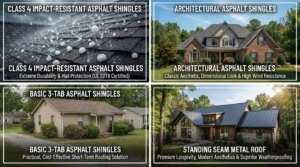
Choosing between asphalt shingle roofing types for your home
Three common scenarios.
Staying 15 or more years, with hail history in your area. Go Class 4. Confirm the insurance credit in writing first, then calculate the payback period. It is frequently shorter than people expect, and you are also buying a roof that will not need a claim after every storm season.
Staying 5 to 15 years, normal exposure. Architectural. It is the right balance of cost, wind performance, and resale appeal for the large majority of homes here, and it is what we install most often.
Rental, outbuilding, or listing the house within two years. 3-tab is defensible. Just be honest about the timeline, because if you are still there in year fourteen, you will be replacing it.
Considering leaving asphalt entirely? Metal is worth a look for long-term owners. We compared the two directly in metal roofing vs asphalt shingles, and there is a broader overview in our guide to roofing materials.
Frequently asked questions
Q: Which of the asphalt shingle roofing types lasts longest?
A: Class 4 impact-resistant, followed by architectural, followed by 3-tab. But the gap between them narrows or widens considerably based on installation quality and attic ventilation. A well-installed architectural roof on a properly vented attic will outlast a badly installed Class 4 roof every time. We go deeper into how long a shingle roof lasts in Middle Tennessee.
Q: Can I put new shingles over my old ones?
A: Tennessee residential code generally permits a maximum of two roof coverings. It is cheaper upfront, but you lose the ability to inspect the decking, you add significant weight, and the new shingles telegraph every irregularity underneath. It also traps heat, which shortens the new roof’s life. We recommend a full tear-off in almost every case.
Q: Will Class 4 shingles definitely lower my insurance premium?
A: Not automatically. The discount is carrier-specific, and you typically need to submit the manufacturer’s UL 2218 certification. Call your agent before you order material and ask for the credit in writing. Some carriers offer a substantial reduction; others offer nothing.
Q: Does shingle color affect how long my roof lasts?
A: Marginally. Lighter colors reflect more solar radiation and run cooler, which slows asphalt degradation. In Tennessee’s climate, the effect is real but small next to ventilation quality. If energy efficiency is a priority, look for products listed with ENERGY STAR.
Q: How often should I have the roof inspected?
A: Annually, plus after any significant hail or wind event. Our Tennessee roof inspection page covers what a proper inspection includes, and there is a seasonal checklist in our roof maintenance guide.
Getting a straight answer for your roof
Spec sheets only take you so far. The right choice among the asphalt shingle roofing types depends on your roof’s pitch and exposure, your attic ventilation, how long you are staying, and what your insurance carrier actually credits.
If you would like someone to look at the actual roof rather than the spec sheet, Veteran Roofing Systems handles asphalt shingle roofing across Middle Tennessee, and we work out of Columbia. You can see our full coverage on our Columbia roofing page, or request a free estimate, and we will tell you what you have and what it needs, including if the answer is nothing yet.
Roofers in Brentwood TN for Roof Replacement Checklist
Finding the right roofers in Brentwood TN for roof replacement can feel overwhelming, especially when every company you call promises […]
Read More… from Roofers in Brentwood TN for Roof Replacement Checklist

Commercial Roofers Nashville: Proven Ways to Extend Roof Life
If you own or manage a commercial property in Middle Tennessee, your roof is one of the most expensive assets to […]
Read More… from Commercial Roofers Nashville: Proven Ways to Extend Roof Life

TPO Roofing Cost: How Much Does It Cost in 2026?
TPO (Thermoplastic Polyolefin) roofing remains one of the most popular and cost-effective flat roofing systems in 2026. Property owners searching […]
Read More… from TPO Roofing Cost: How Much Does It Cost in 2026?